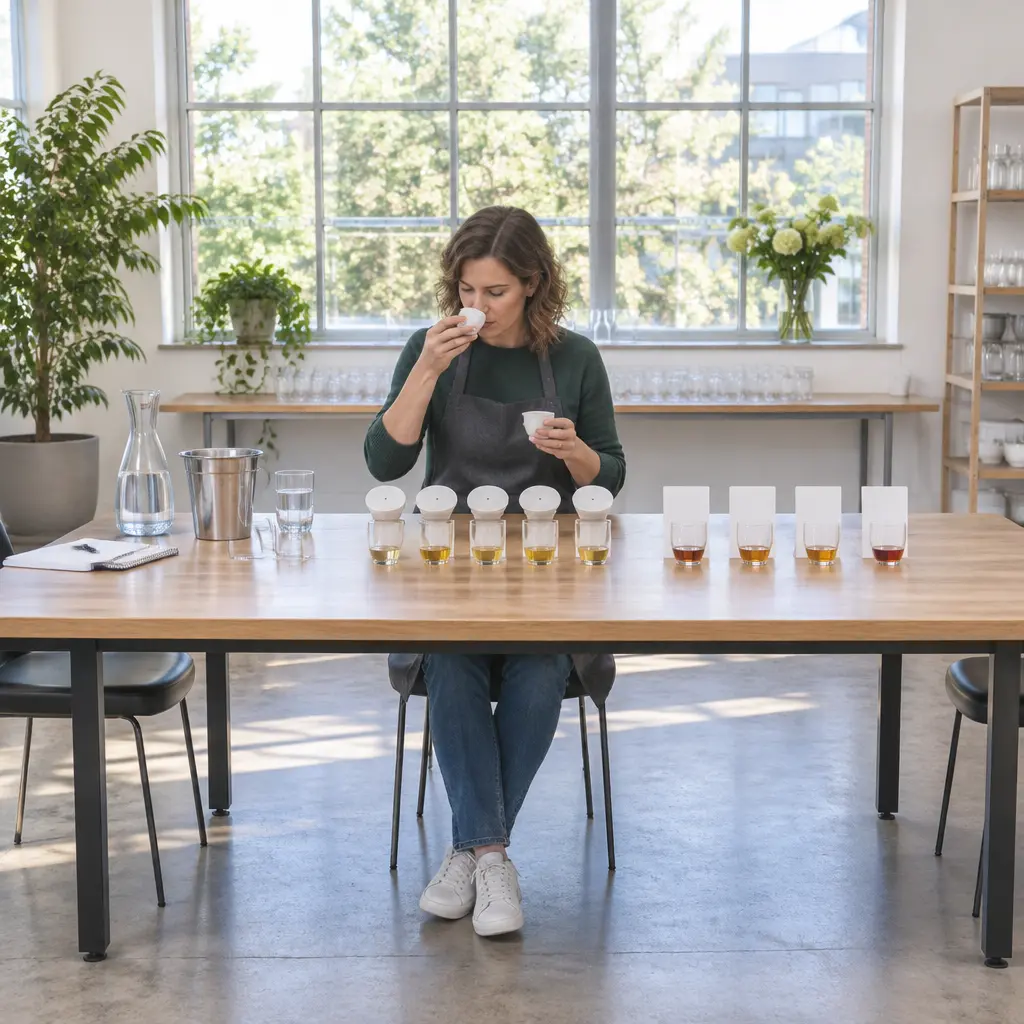
Tasting-skill development is the systematic practice of detecting, describing, and comparing sensory qualities in foods and beverages. To calibrate a palate, tasters should compare their judgments with stable reference standards—such as known concentrations of sweetness, acidity, bitterness, or aroma—not treat a group’s majority opinion as the definition of correct perception. Research on sensory evaluation shows why: trained panels use shared procedures and controlled samples to improve consistency, while individual sensitivity and expectations can still differ. The practical approach is to learn a vocabulary, taste blind where possible, record observations, and repeatedly check them against documented standards.
Calibration connects tasting skill development to reference standards
A reference standard is a defined stimulus or sample used as a comparison point. In sensory science, standards can be chemical compounds, prepared solutions, aroma materials, or products with established characteristics. The International Organization for Standardization (ISO) describes sensory analysis as the examination of product attributes perceived by the senses under controlled conditions. This makes calibration a comparison with an agreed stimulus and procedure, rather than a vote on whether a flavor description sounds persuasive.
The distinction matters because taste is both biological and learned. People differ in sensitivity, prior experience, attention, and expectations; even the same person may judge a sample differently when its label or context changes. A reference does not make every taster experience a sensation identically. It gives tasters a reproducible anchor so they can identify what they perceive, communicate it, and notice where their judgments diverge.
Useful reference categories include intensity standards, identification standards, descriptive standards, and performance checks. For example, a taster might use a series of sucrose solutions to learn sweetness intensity, a known aroma to practice recognition, and repeated blind samples to check whether their ratings remain stable. These tools are relevant in coffee, wine, tea, beer, chocolate, culinary quality control, and product development.
Intensity standards: learning a sensory scale
An intensity standard is a sample with a known or carefully controlled level of a sensation. A sweetness ladder might contain several concentrations of sucrose in water; an acidity exercise might use food-grade citric acid solutions. Tasting samples in ascending or randomized order helps learners connect words such as “faint,” “moderate,” and “strong” to actual stimuli. The standards should be prepared consistently, served at comparable temperatures, and labeled with codes rather than revealing the answer before tasting.
Intensity scales are not universal measures of human experience: a numerical rating is meaningful only when the scale and protocol are understood. ISO 4121 provides guidance for using quantitative response scales in sensory analysis. In practice, a trainer can ask tasters to rate a series, repeat selected samples, and compare the pattern with the intended order. The goal is not to force identical scores but to improve discrimination and make the scale interpretable.
Identification standards: recognizing tastes and aromas
An identification standard is a known substance or aroma used to teach recognition. Basic taste training commonly includes sweet, sour, salty, bitter, and umami examples. Aroma standards may represent familiar categories such as citrus, toasted, floral, or earthy. The standard gives a name to a sensory reference, while repeated exposure builds the association between the name and the perceived character.
The International Organization for Standardization’s ISO 3972 method addresses investigation of sensitivity of taste. A structured exercise can include coded samples, water rinses, breaks, and a recording sheet for identification and confidence. Where safe, food-grade materials and appropriate dilution are essential; instructors should account for allergies, sensitivities, and workplace handling requirements. Recognition should be checked with blind samples, since seeing a label can cue the expected answer.
Descriptive standards: making tasting language observable
A descriptive standard pairs a sensory term with a concrete example or reference material. For instance, “blackcurrant-like” may be illustrated with an agreed aroma reference, while “astringent” can be discussed through the drying sensation associated with certain tannin-rich samples. Such references help a group use terms consistently, but they should not be mistaken for proof that every product contains the named ingredient. Descriptive language reports perceived resemblance, not necessarily chemical composition.
This approach is especially useful when tasters must communicate across roles, locations, or production batches. A glossary can specify the term, its sensory definition, the reference used, and examples of what should not be included. The glossary should be tested and revised when users interpret a term differently. In sensory profiling, trained assessors are commonly given agreed attributes and reference points so that product descriptions can be compared systematically.
Practice turns reference standards into reliable tasting skill
Standards are most useful when paired with deliberate practice. A calibration session should separate stimulus exposure from judgment, limit distractions, and give the taster repeated opportunities to compare perception with a known target. The bridge from learning individual sensations to evaluating whole products is a controlled tasting protocol: consistent serving conditions, coded samples, defined questions, and a record of results.
Blind and randomized tasting: reducing expectation effects
Blind tasting conceals information that could influence judgment, while randomized serving order reduces predictable sequence effects. ISO 8589 describes general guidance for designing sensory test rooms, including provisions intended to reduce distractions and external cues. A simple practice session can use three-digit sample codes, opaque containers when appearance is not under study, and a randomized order prepared by someone who is not rating the samples.
Blindness does not eliminate every source of bias: tasters may infer identity from appearance, temperature, or serving context. It does, however, help distinguish sensory observation from expectation. For example, a coffee learner can taste coded samples before being told the origin or processing method, then compare notes with a reference description afterward. This makes the written description a learning aid rather than an instruction that predetermines what the taster “should” find.
Repeatability and discrimination: checking performance over time
Repeatability is the ability to produce similar judgments under similar conditions; discrimination is the ability to detect a difference between samples. Both are more informative than agreement with a charismatic instructor or the majority of a tasting group. Learners can test repeatability by including the same sample twice under different codes and test discrimination with matched samples that differ in one controlled attribute.
A difference test, such as the triangle test described in ISO 4120, presents three samples—two alike and one different—and asks the assessor to identify the odd sample. Under random guessing, the chance of selecting the odd sample is one in three. A single correct answer does not establish expertise; repeated results, suitable sample preparation, and appropriate statistical interpretation are needed. The exercise is valuable because it tests detection without asking tasters to agree on a descriptive label.
Calibration records: tracking confidence as well as accuracy
A calibration record captures sample code, reference target, sensory description, intensity rating, confidence, and any relevant conditions such as tasting order or temperature. Recording confidence helps distinguish a clear perception from a tentative guess. Over multiple sessions, a learner can identify which attributes are stable, which terms are used inconsistently, and which sensations need more practice.
For example, a tea taster might repeatedly compare coded infusions with a known bitterness ladder, then note whether bitterness ratings rise in the expected order. If results vary, the next step is to inspect the procedure—brewing time, water temperature, palate fatigue, or scale interpretation—rather than assume that peer consensus reveals the correct answer. A chart can plot each session’s rating against the standard level, making drift and improvement visible.
Reference-based tasting differs from peer-opinion tasting
Peer discussion can broaden vocabulary and reveal attributes one person missed, but group agreement is not an independent sensory standard. Social influence can cause people to revise reports toward a confident speaker or a perceived consensus. In a well-designed panel, discussion and training may be useful, yet individual ratings are often collected before discussion so that one person’s language does not overwrite another’s observation.
Peer opinions: useful for interpretation, weak as a calibration target
A peer opinion is another person’s perception or interpretation, not a fixed measurement. It can prompt a learner to revisit a sample—for instance, to check for a floral aroma they had not noticed—but should be treated as a hypothesis to test. The learner can retaste blindly, compare with a relevant standard, and record whether the attribute is detectable. This preserves the value of collaboration without turning popularity into evidence.
The distinction is particularly important in open tastings, where labels, price, reputation, and group conversation can shape expectations. A practical rule is to write an independent first impression before hearing others’ descriptions. Then compare notes and return to the sample or standard. This supports both independent sensory judgment and a shared vocabulary.
Reference standards: anchors, not absolute truth
A reference standard is a controlled comparison point, not a claim that sensory experience is identical for everyone. Standards can vary with preparation, storage, age, and the person’s sensitivity. They should therefore be checked for condition and suitability, and replaced or refreshed when their characteristics change. A standard also needs to match the question: a chemical reference may help identify an aroma, while a real product sample may better represent a complex sensory profile.
This qualification prevents overconfidence. If a learner does not detect a reference, possible explanations include low sensitivity, a weak or degraded standard, poor serving conditions, temporary adaptation, or unfamiliarity with the term. Repeating the test and checking the materials is more informative than simply declaring the learner wrong.
A practical calibration routine develops a more dependable palate
A useful routine progresses from simple stimuli to complex products and from guided exposure to blind assessment. Keep sessions short enough to limit fatigue, use safe and consistent materials, and avoid strong foods, fragrances, smoking, or other conditions likely to interfere with perception immediately beforehand.
- Choose one attribute, such as sweetness, acidity, bitterness, or a specific aroma family.
- Prepare several clearly differentiated reference levels or known examples using a consistent method.
- Taste coded samples in a randomized order and record the observation before discussing it.
- Repeat selected samples to check consistency, and include a blind duplicate or a difference test when appropriate.
- Compare results with the reference key, note uncertainty, and repeat the exercise in a later session.
In coffee training, for example, a learner can practice with aroma references and controlled differences in roast or acidity before evaluating a full cup. In wine or tea, a group can agree on a descriptive glossary but collect individual notes before discussion. In food manufacturing, trained panelists can use reference samples to monitor whether a product’s sensory profile remains within defined expectations. Across these applications, the standard provides the anchor and the tasting record shows whether skill is becoming more consistent.
Conclusion: calibrate against standards, then use discussion thoughtfully
Tasting-skill development is strongest when calibration uses defined reference standards, controlled procedures, blind practice, and repeatable records. Intensity and identification standards teach sensory anchors; descriptive standards make vocabulary more consistent; discrimination tests check whether a difference can be detected. Peer opinions can broaden interpretation, but they should not replace evidence from a known reference or a well-designed test.
The broader value is clearer communication and more dependable decisions in quality control, product development, education, and everyday tasting. Start with one attribute, practice against safe and stable references, record both confidence and results, and revisit the exercise over time. For further study, consult ISO sensory-analysis methods and introductory resources from professional sensory-science organizations.
Sources: International Organization for Standardization, ISO 5492:2008 Sensory analysis—Vocabulary, https://www.iso.org/standard/38051.html; International Organization for Standardization, ISO 3972:2011 Sensory analysis—Methodology—Method of investigating sensitivity of taste, https://www.iso.org/standard/50110.html; International Organization for Standardization, ISO 4121:2003 Sensory analysis—Guidelines for the use of quantitative response scales, https://www.iso.org/standard/33817.html; International Organization for Standardization, ISO 4120:2021 Sensory analysis—Methodology—Triangle test, https://www.iso.org/standard/76666.html; International Organization for Standardization, ISO 8589:2007 Sensory analysis—General guidance for the design of test rooms, https://www.iso.org/standard/36385.html; International Organization for Standardization, ISO 13299:2016 Sensory analysis—Methodology—General guidance for establishing a sensory profile, https://www.iso.org/standard/58042.html.